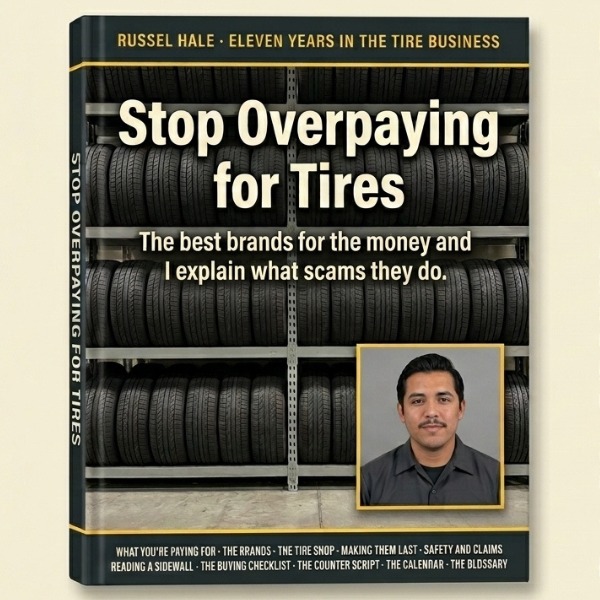
Four years writing the tickets, three more setting the numbers those tickets were built from. This is which line on your bill is the job and which is the upsell — and the other half of the money, the half that leaks out on your own driveway between now and the next set.
Instant download · Yours forever
“Every dollar you overpay on tires leaks out through one of three holes.”
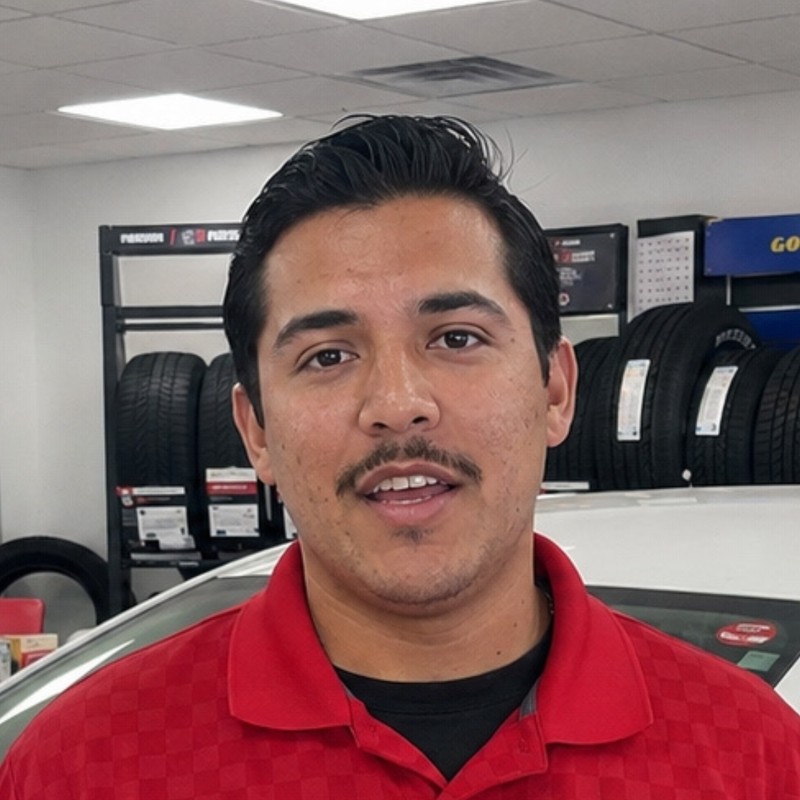
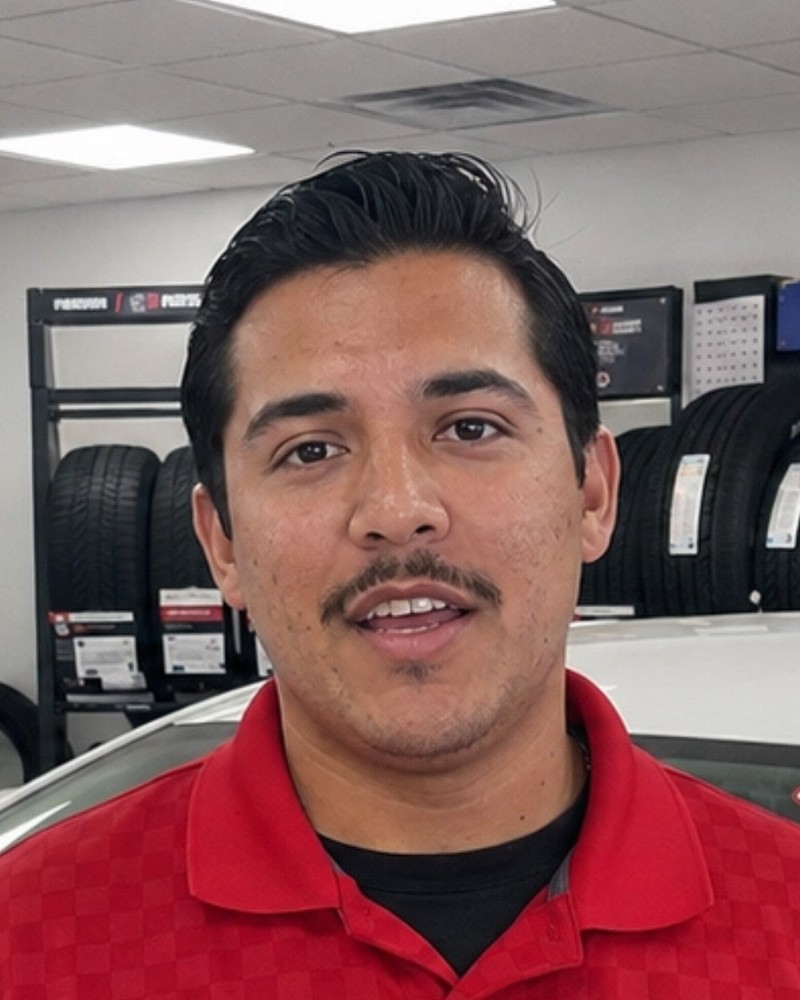
Russel HaleI spent eleven years in the tire business. Four of those years I was the guy behind the counter writing up the tickets, and the last three I was the service manager who set the numbers those tickets were built from. I know exactly how a $600 job turns into a $1,100 job, because for a while there it was my job to make it happen.
I am not going to tell you every tire shop is crooked. That is a lie, and it would make this whole book useless to you. Most of the people working the bays are honest and know their trade. Some of the charges on your bill are completely fair and I defend them in these pages.
If you do not know which line on the ticket is which, you will pay for all of them. Every time. That is the whole reason for this book. Not to make you distrust your local shop — to make you the customer who knows what he is looking at, so the conversation stops being something that happens to you and starts being something you are steering.
The other half of the money is on your own driveway. The average driver in this country throws away somewhere between fifteen and twenty-five thousand miles of good tread over the life of a set — not to any dramatic failure, but to air pressure nobody checked, rotations nobody did, and an alignment that went out of spec two years ago and never got looked at. That is a whole extra set of tires you paid for and never used.
Nothing on it was illegal. About $200 of it bought him nothing at all.
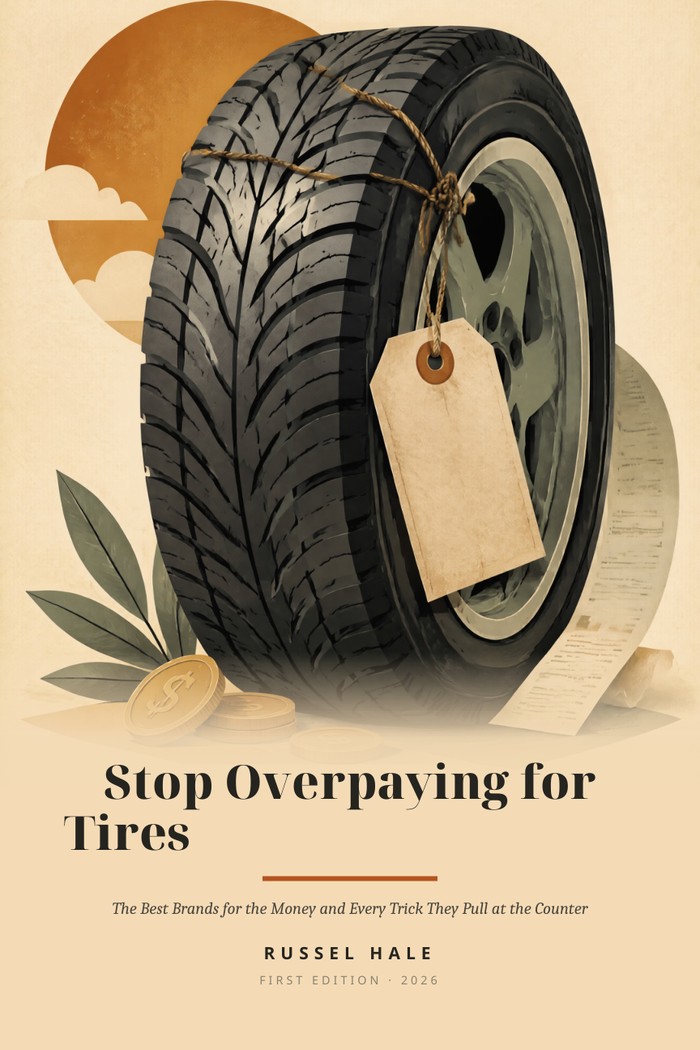
Stop Overpaying for Tires · First Edition · 2026
155 pages · 34 chapters · 6 parts
That is the whole imbalance. The counter guy is not necessarily lying to you — he is working a conversation he knows cold, and you are hearing half of these words for the first time. This book puts you on level ground before you walk in.
Every chapter opens by telling you what the problem is in plain language, walks through what is actually going on with the numbers attached, and ends with what to do about it — stated as a thing you can go and do this week, not as a philosophy.
Instant download · Yours forever
“Read Chapter 14 in the parking lot before I went in. Took the nitrogen and the shop supplies off the quote without an argument — he just crossed them out. Book paid for itself twice on one visit.”
“I have been running 32 in everything for thirty years. My door jamb says 36. Chapter 21 explained why that gap was quietly costing me a set of tires, and I did not believe it until I checked all four.”
“Bought it for my daughter, who was about to buy four tires on her own for the first time. She used the counter script in Chapter 32 nearly word for word and came home under budget.”
Eleven years in the tire business. Four of them behind the counter writing the tickets, three of them as the service manager who set the numbers those tickets were built from. I have sold the nitrogen. I have quoted the road hazard. I know how the conversation is built because for a while there I helped build it.
I am not here to tell you the industry is a scam. It is not. Mounting is real labor, disposal is a real state-regulated cost, and an alignment on a car that needs one is the cheapest money you will ever spend on tires. There is a ditch on both sides of this road, and people drive into the cheap one just as often as the expensive one.
What I am here to do is put the ticket in plain English, tell you where every dollar actually goes, and hand you the words to say at the counter. Then show you the other half — the pressure, the rotations, the wear patterns — that decides whether the set you just bought goes forty-two thousand miles or sixty.
This book is for everybody who has ever stood at a tire counter nodding along to words they did not understand, and paid for it.
The Best Brands for the Money and Every Trick They Pull at the Counter · First Edition
Launch promo · ends at midnight
Get Stop Overpaying for Tires — $47 $27Instant download · Yours forever
No, and if it were it would be useless to you. Most of the people working the bays are honest and know their trade. Mounting and balancing is real labor on a real machine. Disposal is a real state-regulated cost. An alignment on a car that needs one is the best money on the whole ticket, and I say so in Chapter 16.
What I am telling you is that the shop makes a thin margin on the tire and a fat one on everything sold next to it, and the counter conversation is built around that fact. Once you can see which line is which, you stop paying for all of them by default.
The videos are one thing at a time, in whatever order I filmed them. The book is the whole job in order — buying, the ticket, and the four years after you drive away — with the numbers written underneath every claim.
It is also the part you can have open on your phone while you are standing at the counter, with the checklist, the counter script and the glossary in one place instead of scattered across a hundred videos. Keep watching the videos. The book is for when you want all of it.
It is written for the person who knows nothing about tires and says so up front — the man in Chapter 1 was exactly that, and I respected him for it. Nothing in here asks you to do a job you are not equipped for. I show you how to read your own tires and check your own pressure, because those are five-minute jobs anybody can do in a driveway.
I do not tell you to dismount a tire on a rim in your garage or to repair a puncture yourself. Both go wrong in ways that hurt people, and that line does not move.
Every dollar figure in the book is a range, not a quote. Tire prices and labor rates swing by region, by season, and by how big your wheels are — a number that is right in rural Ohio is low in New Jersey. Use the ranges to judge whether what you are being quoted is reasonable in your market, not to argue that a shop in Los Angeles must charge Ohio money.
Because it is a file, not a printed book, and I would rather it be in a thousand gloveboxes than on ten shelves. $47 is what it sells for once the launch promo ends. Until then it is $27 — less than the nitrogen fill and the shop supplies on a single ticket.
Two PDFs, delivered the moment you order. You get the plain book and the Illustrated Edition, which is the same complete text newly typeset with a designed cover. Some people want the pictures, some want the words and nothing else — you get both and decide for yourself.
Either one reads on a phone, a tablet or a computer, and prints cleanly if you would rather have paper in the glovebox, where you will actually have it when you need it. They are yours to keep.

Thirty-four chapters, 155 pages, eleven years behind the counter — both editions — for $27 until the launch promo ends at midnight. After that it is $47. The nitrogen and the shop supplies on a single ticket cost more than this book.
Get Stop Overpaying for Tires — $47 $27 or see what's inside →